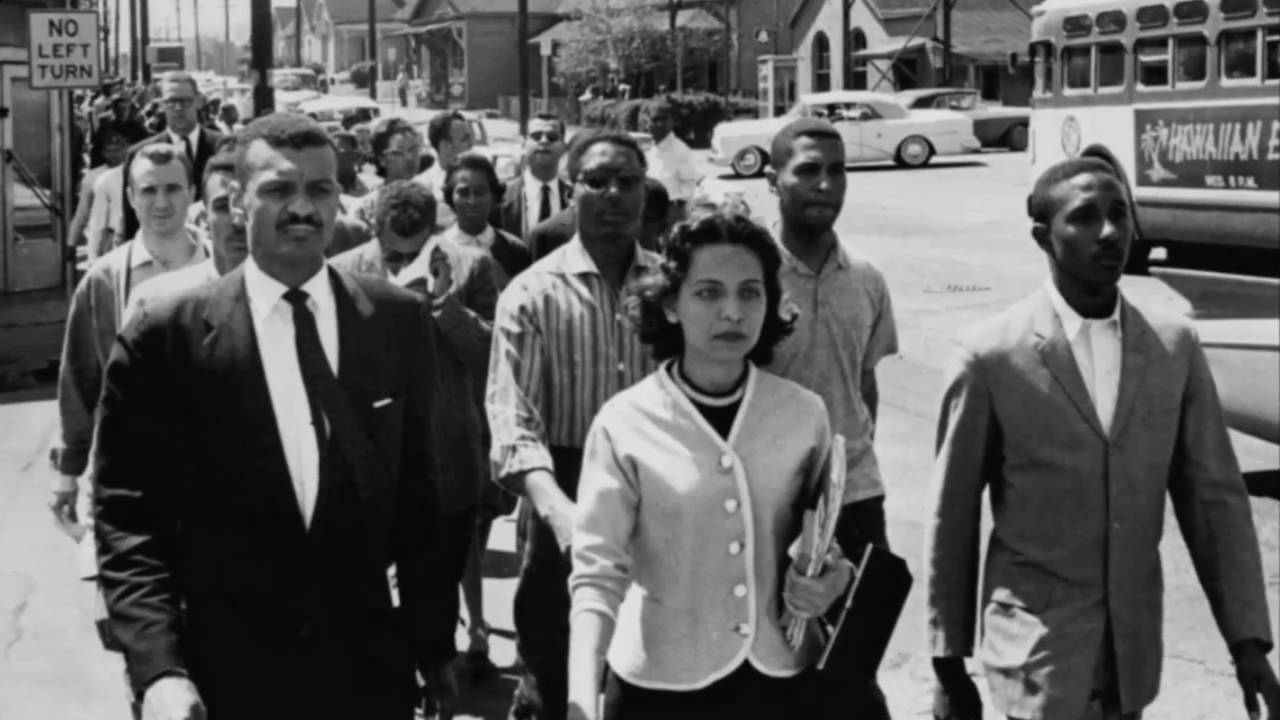
By the start of next class, please watch Eyes on the Prize: “Ain’t Scared of Your Jails (1960–1961)” (below), and then, in your learning journal, please respond to this prompt:
Like the Montgomery Improvement Association, the activists who conducted the Nashville Sit-Ins and the Freedom Rides used specific, concrete instances of racist policy to dramatize the deeper, systemic evil infecting the social order as a whole. And they did so in ways that compelled local, state, and national officials to intervene on their behalf to help dismantle segregation. Famously, the strategies these activists used were grounded in the philosophy and practice of nonviolent resistance.
So, using an example of a specific instance of nonviolent resistance depicted in the film, explain why, in your view, nonviolent resistance proved so effective in "flipping the script." That is, what made nonviolent resistance a uniquely effective way to combat the systemic racism of the segregated South?
Your response should be about 200–300 words. (That's about a half a double-spaced page.)
To help you, here's the definition of systemic racism that we used in class:
Systemic racism: A [social structure] in which public policies, institutional practices, cultural representations, and other norms work in various, often reinforcing ways to perpetuate racial group inequity. [The term] identifies dimensions of our history and culture that have allowed privileges associated with “whiteness” and disadvantages associated with “color” to endure and adapt over time. [Systemic] racism is not something that a few people or institutions choose to practice. Instead it has been a feature of the social, economic and political systems in which we all exist.
“Glossary for Understanding the Dismantling Structural Racism/Promoting Racial EquityAnalysis,” from The Aspen Institute Roundtable on Community ChangeAlso, the philosophy and practice of nonviolent resistance is discussed in the documentary. But you can learn more by reading "The Six Principles of Nonviolence" outlined at the King Center for Nonviolent Social Change website.
