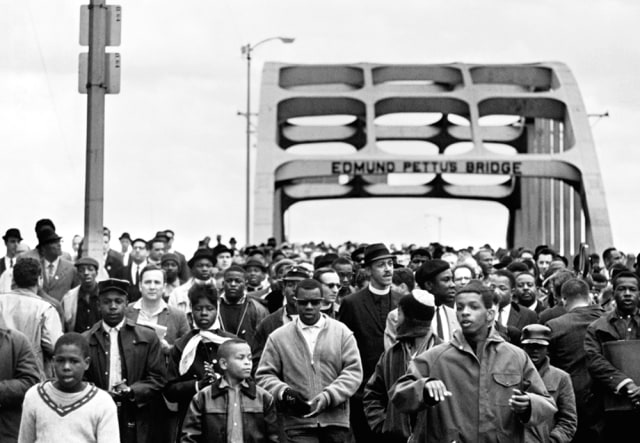
By the start of next class, please watch Ava DuVernay's Selma and respond (in your learning journal) to this prompt:
Nonviolent resistance campaigns involve a good deal of improvisation. Activists must decide, in the moment, if and how to respond to pressure points as they arise. A pressure point is a moment at which the power dynamic can be shifted in the campaign's favor through a nonviolent action that pressures other stakeholders (i.e., rhetorical audiences) to take action themselves. Sometimes the other stakeholders' actions directly advance the campaign's goal (as when the mayor of Nashville was persuaded to admit that he believed segregated lunch counters to be morally wrong). And sometimes the other stakeholders' actions advances the campaign's goal indirectly, unwittingly, or unwillingly (as when Birmingham Police Commissioner Bull Connor arranged for violent attacks to be directed against the Freedom Riders, thus prompting Attorney General Robert Kennedy to intervene against Connor and on the Riders' behalf).
In your learning journal, please list three such pressure points as depicted in Selma, and be prepared to discuss in class (1) if and how Civil Rights Movement activists responded to each pressure point (i.e., with what specific nonviolent action), (2) what action the other stakeholders took in response, and (3) whether and why the activists' strategy succeeded in advancing the Movement's overall goal.
(Please note that I'm asking you to be prepared to talk in class about (1)-(3); I'm not asking you to write out your analysis beforehand. All you need to do in your journal is list the pressure points.)You can stream Selma via Canvas; it's under "Modules" (left column), in the "Selma" folder, and titled "Selma (streaming video)." FYI: The film is a little over two hours long.
Here are the slides we looked at in class:
P.S. if you'd like to learn more about DU Prof Erica Chenoweth's work on nonviolence, then you can watch her TED Talk.
